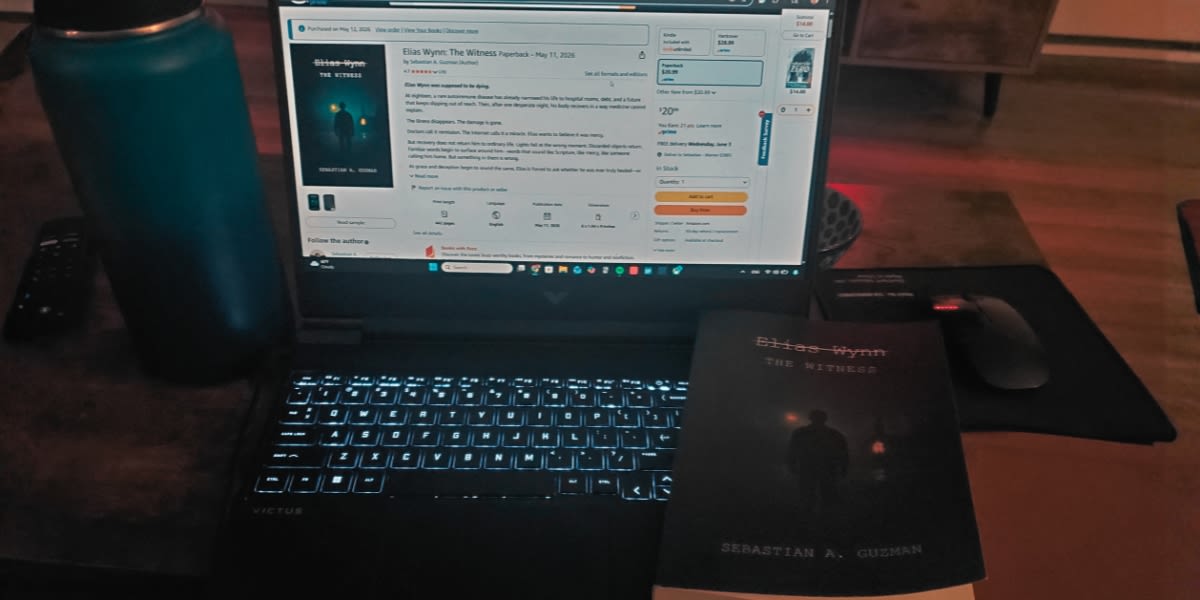
It has been about three weeks since Elias Wynn: The Witness released on May 11.
Which is strange to write, because for so long this book only existed in my head, my laptop, my notes, my edits, my Canva drafts, my overthinking, and the occasional moment where I stared at the screen wondering if I had lost my mind.
Now it is outside of me.
People can read it. People can judge it. People can misunderstand it. People can connect with it. People can close the book and carry something from it that I may never know about.
That part is beautiful.
It is also terrifying.
I do not think anyone really prepares you for the emotional weirdness of releasing a debut novel. Everyone talks about the practical side, and they should. You need the cover. The blurb. The formats. The links. The posts. The emails. The launch plan. The ads. The reviews. The endless small details that make you question whether becoming an author is actually just becoming a full-time admin assistant for your own imagination.
But the part I did not fully expect was the silence after release.
Not bad silence. Just the strange silence of having spent months carrying a story like it was a living thing, only to finally place it in someone else’s hands and realize you cannot follow it into the room.
You cannot explain every scene.
You cannot sit beside every reader and say, “Wait, that line matters.”
You cannot defend every choice.
You cannot control what people feel.
You just have to let the book speak.
That is harder than I thought.
The Witness came out of a season where life did not feel simple. I was dealing with illness, fear, weakness, faith, therapy, questions about healing, and the uncomfortable reality that sometimes suffering does not fit into a clean inspirational quote.
I did not want to write a story that pretended pain was easy.
I also did not want to write a story that treated darkness like it was stronger than God.
So I wrote Elias Wynn.
An eighteen-year-old boy who should have died, survives, and then has to face the terrifying question of whether every “miracle” should be trusted.
That question became the spine of the book.
Not because I do not believe in miracles.
I do.
But because I also believe desperation can make people vulnerable. Pain can make us hungry for relief. Fear can make anything that offers escape look like mercy. And sometimes the most dangerous thing is not suffering itself, but what we are willing to surrender in order to make it stop.
That is the heart of The Witness.
Not just horror.
Not just mystery.
Not just “what happened to Elias?”
But what happens to a soul when healing, suffering, faith, trauma, and temptation all collide?
Three weeks after release, I think I am still learning how to talk about this book without sounding like I am trying to sell a haunted medical file at a yard sale.
Because yes, I want people to read it.
Of course I do.
I wrote the book. Edited the book. published the book. Now I have to convince the internet I am not annoying. This is apparently the real trial.
But deeper than that, I want the right readers to find it.
Readers who have suffered and do not want fake answers.
Readers who believe in God but still have questions.
Readers who enjoy psychological thrillers, supernatural horror, and stories where the spiritual tension actually matters.
Readers who know that faith is not always clean. Sometimes faith is trembling. Sometimes faith is crawling. Sometimes faith is just refusing to let go of the light when everything in you is tired.
That phrase has followed the book from the beginning:
Stay with the light.
It sounds simple.
It is not.
Especially when you are sick. Especially when you are scared. Especially when your mind is loud. Especially when your body feels like it betrayed you. Especially when you have survived abuse. Especially when the thing offering relief sounds kinder than the truth.
That is where Elias lives.
And honestly, that is where a lot of us live too.
Three weeks in, I am grateful. Tired, but grateful. Nervous, but grateful. A little overwhelmed by marketing, because apparently books do not magically fly into strangers’ hands through sheer emotional intensity, but still grateful.
I am grateful for every person who has bought it, read it, reviewed it, shared it, prayed for it, or even just taken the time to say, “This sounds interesting.”
For a debut author, those small things matter more than people realize.
This book began as a place to wrestle with suffering.
Now it is becoming a bridge to readers I have never met.
That is wild.
And if you have already started reading Elias Wynn: The Witness, thank you.
If you have finished it, thank you twice, because finishing an 97,000-word psychological thriller in this attention span economy is basically an Olympic event.
And if you have not read it yet, maybe this is your sign.
Not a pushy sign.
Not a “the algorithm commands you” sign.
Just a quiet one.
A boy survives what should have killed him.
But the miracle may not have come alone.
Stay with the light.
Elias Wynn: The Witness is available now in Kindle, paperback, and hardcover on Amazon. Kindle Unlimited readers can read it there too.