I’m staring at a Canva draft right now.
It’s for a promotional graphic.
The colors are too bright.
The font is too cheerful.
It feels… wrong.
It feels like the way we often talk about faith in public.
Like a filter.
Like a layer of varnish over a piece of wood that’s actually rotting underneath.
I’m a debut author. I just put Elias Wynn: The Witness out into the world.
And I am terrified.
I am terrified because I didn't write a "safe" book.
I didn't write a book where the clouds part in chapter three and everyone finds a parking spot because they prayed.
I wrote a book about a kid with an autoimmune disease.
I wrote about medical debt.
I wrote about lights failing and objects returning and a "miracle" that feels like a threat.
Because lately, I’ve been thinking about Christian fiction.
And I’ve been thinking about how much of it feels like a Hallmark card.
Sanitized.
Polished.
Predictable.
But then I open my Bible.
And I realize that the story God tells is none of those things.
The Sanitization of the Soul
We have a habit of cleaning up the messy parts.
We want the redemption without the wreckage.
We want the "after" photo without the "during."
Too much modern Christian fiction feels like it’s preaching to the choir.
It’s on-the-nose.
It’s aggressive.
It announces its faith so loudly that it loses the very thing that makes faith beautiful: the struggle.
When a story is too clean, it stops being true.
When a character is too perfect, they stop being human.
When the ending is too neat, it stops being a miracle and starts being a cliché.
I’ve spent time in the back of ambulances as an EMT.
I’ve spent time living in a country as a kid that wasn't mine, seeing poverty, violence, death threats, slums at a level that the US itself would be grateful that they have the country they do.
I’ve spent time in a hospital bed myself, diagnosed with a rare autoimmune disease (GPA) that changed the trajectory of my life.
Life isn't clean.
Faith isn't a straight line.
Why should our stories pretend they are?

The Unsanitized Scripture
If you think the Bible is "safe," you haven't been reading it.
You cannot read the Book of Judges and call it sanitized.
You cannot read Job’s lament and call it "clean."
You cannot look at the sweat like drops of blood in Gethsemane and call it a light read.
The Bible is raw.
It is disturbing.
It is unflinching in its portrayal of human darkness, sin, and violence.
It doesn’t shy away from the depths of the human heart.
Especially when things don't make sense.
Especially when the "healed" still hurt.
Especially when the silence of God feels heavy.
If someone can read Scripture all day but recoils from anything "dark" in fiction, I wonder if they’re missing the connection.
The darkness in a story isn’t there to celebrate the dark.
It’s there to make the light mean something.
You can’t see the stars if the sun is always up.
Architecture, Not a Megaphone
I want to write with "quiet power."
I want to write like Tolkien.
I want to write like Lewis.
In Middle-earth, you don’t see a cross on every hill.
You don’t hear a sermon in every chapter.
Yet, the faith is there.
It is the architecture of the world.
It is the moral gravity.
It is the subtle current running beneath the surface.
Their faith wasn’t tacked on.
It wasn’t shouted.
It infused the work.
I’m not interested in religiosity.
I’m not interested in hypocrisy.
I want the message to live through the story, not as a replacement for it.
When the goal is to reach people who don’t yet know God: or who are only beginning to wonder: we need to pull theology out of the spotlight.
We need to let it breathe.

Faith as Breath (Ruach)
In Hebrew, the word for Spirit is Ruach.
It means breath.
Think about your breath.
You are doing it right now.
You rarely think about it moment by moment.
Yet, it is the only thing keeping you alive.
It is foundational to your reality, but it operates subtly in the background.
That is how I want faith to feel in my writing.
Organic.
Grounded.
Vital.
In Elias Wynn: The Witness, Elias is grappling with a recovery that doesn't feel like a gift.
The spiritual reality in his life sounds like Scripture, but it carries a "wrongness."
He has to ask: Was I truly healed, or only claimed?
That is a heavy question.
It’s a psychological thriller question.
It’s a horror question.
But it’s also a deeply human question.
Why the Thriller?
People ask me why I lean into psychological suspense and horror.
It’s because trauma doesn't feel like a cozy mystery.
Suffering doesn't feel like a rom-com.
Trauma feels like the floor dropping out.
Trauma feels like a shadow in the corner of your eye.
Trauma feels like a story where the rules have changed and you don't have the new guidebook yet.
By using the tools of the thriller, I can explore the "backstage" reality of the soul.
The overthinking.
The fear.
The unglamorous wrestling match with the Divine.
I want to show the work.
I want to admit that I don't have all the answers.
I want to sit in the tension between miracle and manipulation.
Because that is where most of us actually live.

Real Darkness. Real Redemption.
I’m tired of stories that offer easy cliches.
I’m tired of "Christian" being a synonym for "safe."
I’m tired of the idea that if we show the darkness, we are somehow betraying the light.
The light doesn't need us to protect it.
It needs us to be honest.
I wrote this book for the people who aren't afraid of the heavy stuff.
For the people who have experienced trauma and want a story that honors that complexity.
For the Christians who are willing to have their faith challenged so it can actually be strengthened.
It is terrifying to be this honest.
But it is the only way I know how to write.
If you’re looking for a "clean" read, you might want to look elsewhere.
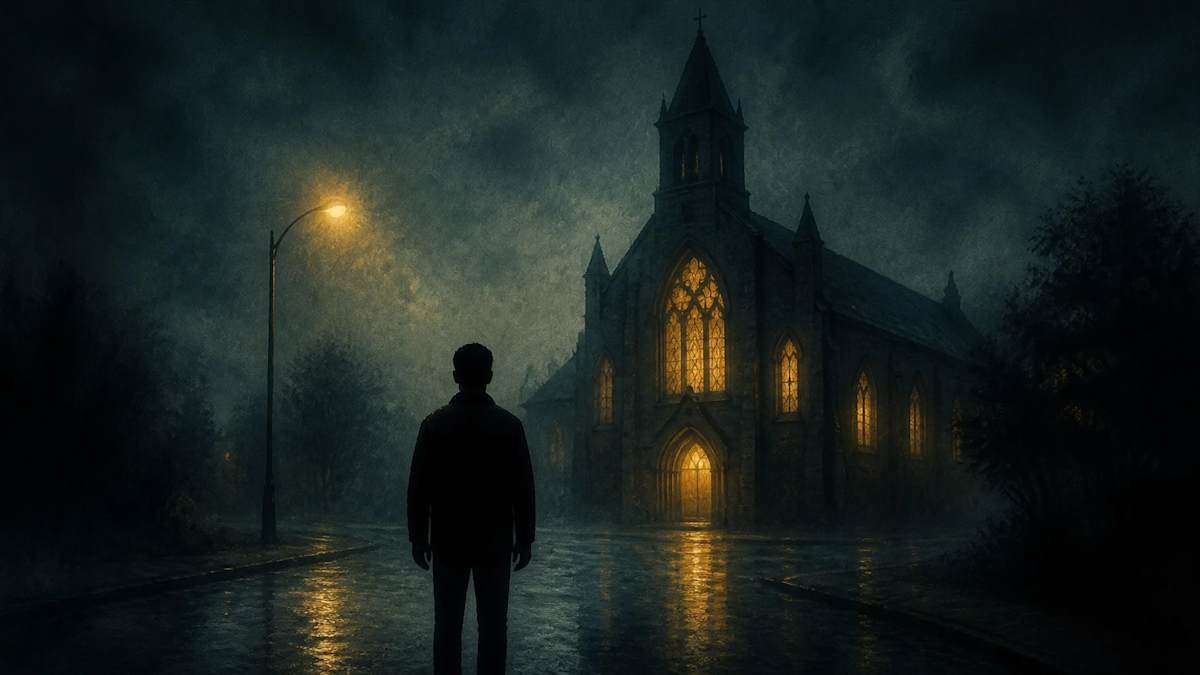
But if you’re looking for a story that sits in the rain with you, waiting for the light to break through…
Then maybe you’re a Witness, too.
Stay grounded.
Stay honest.
Search for the light.
: Sebastian

If you want to follow along with this journey of faith, fiction, and the messy in-between, join my mailing list. I promise not to be too cheerful.